Your basket is currently empty!
 En
En  Da
Da Fr
Fr De
De
Education in the Iron Age
Get an overview of the different educational offers in Lejre Land of Legends’ Iron Age village.

Travel back to the Iron Age with your class!
The period
The Iron Age
Area general learning objectives
Students learn about life in the Iron Age and about non-Christian religions and beliefs.
Students can investigate, put into perspective their own life world and put their first-hand experiences into words.
Students practice using history and understanding chronology by helping to create historical scenarios.

The Iron Age environment & the village of Lethra
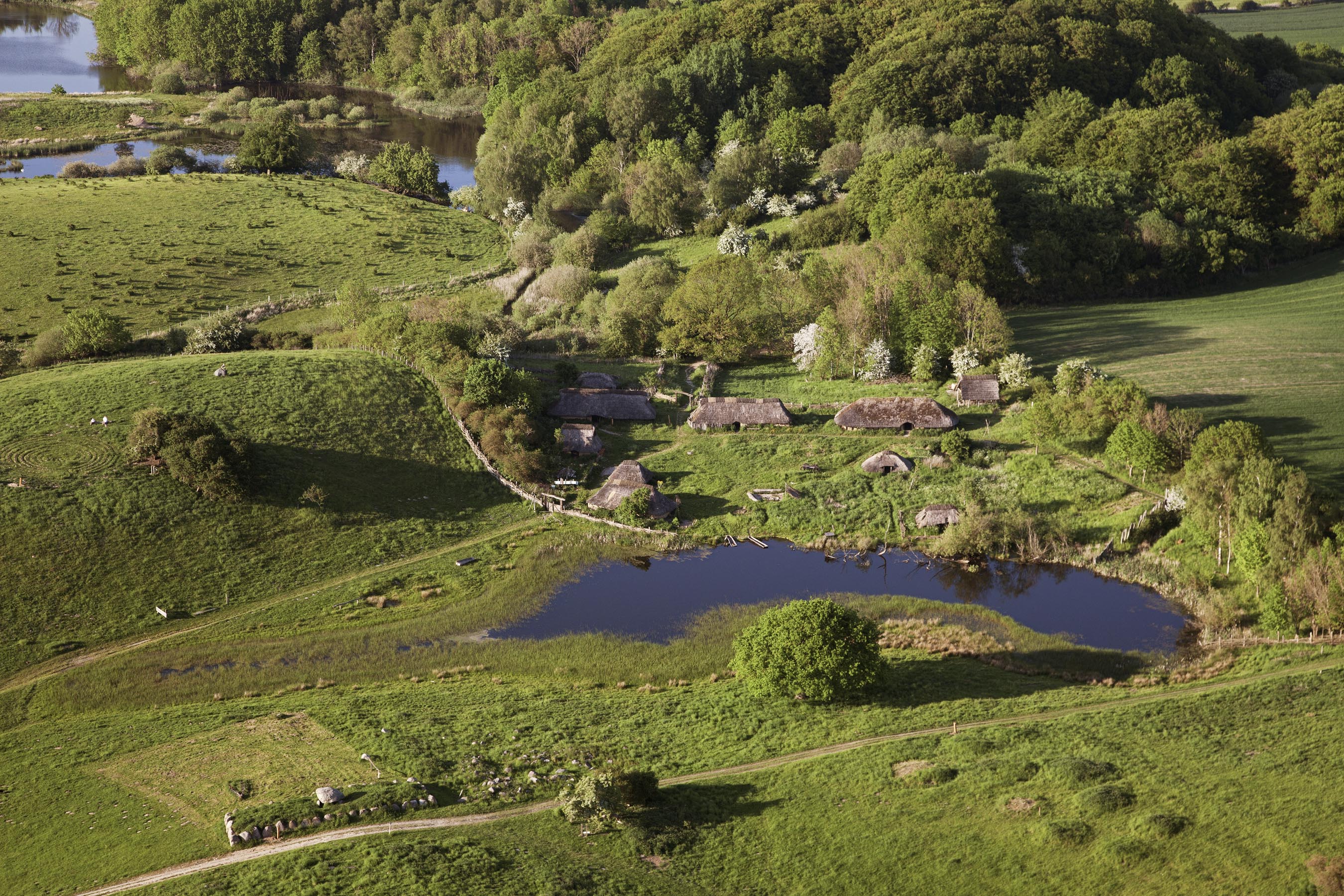
LLethra is a reconstruction of a small village that reflects the time from around 200 BC – 200 AD. Students experience a journey 2000 years back in time, when the Iron Age people lived in small chiefdoms while Emperor Augustus ruled the Roman Empire. The Iron Age is part of Denmark’s prehistory, spanning a period of 1250 years, from 500 BC to 750 AD. Depending on the influence that came from the rest of Europe, a distinction is made between the Celtic/Pre-Roman Iron Age from 500 BC to AD 0, the Roman Iron Age from AD 0 to AD 400 and the Germanic Iron Age from AD 400 to 750.
Climate change and the end of bronze imports in the late Bronze Age, in the wake of Celtic and then Roman expansion in Europe, created the basis for the development of iron mining. This created many changes in northern societies. There were often conflicts over land and resources, and war became part of everyday life. During this time, the old North Germanic tribal society was restructured, leading to a redistribution and intensification of land use and the creation of new communities and territories.
During the 1st century AD, alliances and allies became a necessity for survival. At the same time, these created larger centers of power over small tribal communities from isolated farmsteads to growing villages. Thus, Iron Age society in the Danish area was both shaped by local conditions and came under the influence of long-distance trade and interests.
The class is welcomed into the territory of the farming community with residential houses, a weaving house, a wood forge and a smithy with an iron extraction site and a fence house. In addition to several small buildings, Lethra is associated with cultivated fields, field and forest overgrowth, an atmospheric sacrificial bog and a burial ground. In their roles, several of the villagers have become acquainted with the Celts and Romans, for better or worse. As eyewitnesses, they can talk about their equipment, experiences and relationships.
A day in Lethra
After a hands-on informative reception at our Welcome Center, students are taken to the village of Lethra and welcomed to Iron Age life around 0 AD. Hands-on activities, skits and stories give an insight into what everyday life in the Iron Age might have been like. Craft activities and stories by teachers in costume and role bring the Iron Age under the students’ skin.
The home village your class comes from feels threatened by the neighboring village. You’ve heard that the people from the village of Lethra are doing well with the chief. You have come to Lethra to form an alliance with the people there. It’s good to get to know each other and work together. The villagers set you to work on various tasks. You work hard together and the people of Lethra join you in a sacrificial ceremony in the sacrificial bog to seal the alliance.
There are often two different classes visiting the village at the same time. Half of the class works on keeping house and preparing food in the Iron Age style. The other half of the students work on a craft typical of the period, blacksmithing. The students will demonstrate and partially test tools in various work processes, including wood chopping. At around 11:30, the class gathers for a short lunch break before going back to their respective activities. There will be a joint trip to the sacrificial bog. After the sacrificial ceremony, the class will be seated in the Iron Age house, where the food is tasted together and experiences, knowledge and experiences are exchanged. At 13:15, the tour returns to the present.
A day in Lethra
Duration
3 hours, from 10:15 – 13:15.
The class has two teachers who work in the costumes and roles of Iron Age people.
The program supports the Common Objectives in the subjects history, Christian studies, crafts and design.
History canon: Emperor Augustus
Grade level
3.- 6th grade
The course is organized so that students are given age-appropriate tasks. Max. 28 students.
Specific learning objectives
The course supports the students’ historical awareness and understanding of chronology, brings different source material (reconstructions, stories and eyewitness accounts from the instructors’ characters) into play, supports source-critical analysis and leaves room for the students’ own interpretations and reflection on interaction with their own life world.
The price for a class of max. 28 students is 2.550,- for the course.

Contact us to book
kontakt@sagnlandet.dk
+45 46 48 08 78
Lejre Land of Legends
Slangealleen 2
4320 Lejre, Denmark
CVR: 33247257
Meet a Gallic refugee
After a practical informative reception at our welcome center at 10:15 or 12:30, students are led by the teacher in costume and role, 2,000 years back to the Iron Age village of Lethra. A refugee from the tribe of the Allobrogs, from Eastern Gaul in the northern French Alps, he belonged to one of the most influential peoples in Iron Age Europe compared to the Roman Empire.
Here the teacher arrived in Lethra around year 0. On a short walking tour, he tells us about the world of the Celts and Germanic peoples under Roman influence. About the Celts who expanded across Europe and influenced the whole area with iron technology, burial customs and sacrificial rituals. Is it true that they sacrificed and beheaded people? What brought Jarund here, who did he meet on his way and how was he received? How did he get there and how long did his journey take?
Together with the teacher, you’ll find the answers as you wander through the Iron Age environment, viewing various illustrative objects and learning about different aspects of life back then. You’ll hear the crackling fire and learn about the enemies, the Roman Empire and Emperor Augustus. You’ll also talk about your thoughts on his situation and how it differs from today’s refugees.
At the end in the sacrificial bog, you’ll hear about the Celtic gods, sacrificial sites and rituals. Experiences, knowledge and insights will be exchanged before your departure at 12:15 or 14:30, back to the present.
Meet a Gallic refugee
Duration
2 hours, 10:15 – 12:15 or 12:30 – 14:30.
The class has one teacher in the costume and role of an Iron Age man. The course supports the Common Objectives in the subjects of history, geography and Christianity.
Class level
3.6th-6th grade.
The course is organized so that students are given age-appropriate tasks. Max. 28 students.
Specific learning objectives
The course supports chronological understanding. Students can relate to life’s ethical issues such as the refugee problem and can compare their experiences with their own knowledge and experience.
The course uses different source material (reconstructions, narratives and eyewitness accounts from the instructor’s character) and supports source-critical analysis. Students can use source-critical concepts to explain interpretations of the past based on simple problems.
Students will strengthen their ability to empathize and identify. Students will strengthen their ability to wonder and ask questions.
The price for a class of max. 28 students is 1.650,- for the course.

Contact us to book
kontakt@sagnlandet.dk
+45 46 48 08 78
Lejre Land of Legends
Slangealleen 2
4320 Lejre, Denmark
CVR: 33247257
The gifts of the gods
Archaeological finds and historical sources testify that our ancestors engaged in cultic acts. But how this happened, we can only speculate. Witnesses in costume and role from two eras give their take on it and take you on a journey through time to get the spiritual and mental side under your skin. This course takes you back to the Iron Age and the Viking Age. Together, we’ll make four journeys that shed light on different aspects of the subject of sacrifice.
- You will visit an Iron Age house with a focus on the Iron Age people’s daily life around the hearth, their household gods and special conditions that have reference to archaeological finds. Illustrative objects will be used to illustrate various topics related to sacrificial rituals within the Iron Age village.
- In Lethra’s sacrificial bog you will experience the Iron Age cult site and perform a sacrificial ritual. Here you will learn why sacrifices were made and learn about fertility rituals, gods and goddesses. The session is illuminated through the accounts of Tacitus, the first known ethnographic account or enlightenment work for the Roman Empire, which describes the Germanic tribes.
- In Viking territory, firewood is chopped, bread biscuits are baked and butter is whipped. In line with an animistic way of thinking known from the Viking worldview, where nature is animated and everything has and is a being, the students decorate bread biscuits with the rune of the day and make a string in which they place wishes and thoughts about the past and future. Students prepare and decorate an offering plate. There is also time for a story.
- A common toast is made to future achievements and a common sacrifice is made, a blot at Gudehorgen. Here the Viking area has brought to life the legal scholar Ahmad Ibn Fadlan’s description of a sacrificial site in the Volga region. There may also be time for a visit to the King’s Hall, where the tree of life, Ask Yggdrasil and the norns (goddesses of fate) come into play.
The gifts of the gods
Duration
3 hours, from 10:15 – 13:15
The course is booked by two classes with two facilitators in costume and role in each age. When switching to the other age at approximately 11:35, there is a short lunch break while you move from one area to the other.
The program can also be booked for one class at a time as a 1½ hour program in the Iron Age area or in the Viking area with one educator in costume and role.
Grade level
4.7th-7th grade. The program is designed to provide age-appropriate challenges for the students. Max 28 students per class + 2-3 adults.
Specific learning objectives
Students reflect on the beliefs that constitute sacrificial rituals. Students gain knowledge of non-Christian religions and beliefs.
With “sacrifice” as the theme for a universal human act, students gain a reflective understanding of what human beings are, what life can offer, and how we can relate to this and have related to it in relation to ethical life issues.
In terms of the students’ all-round development, students learn together with others about the common humanity.
The price for two classes of max. 28 students each is DKK 5,100 for the course.

Contact us to book
kontakt@sagnlandet.dk
+45 46 48 08 78
Lejre Land of Legends
Slangealleen 2
4320 Lejre, Denmark
CVR: 33247257
Our other offers
Education in the Stone Age
Discover the first hunters and fishermen in Denmark or experience life from Ice Age hunter to forester.
Learning about the Viking Age
Become a Viking for a day or try Viking sports. Arrive at the Viking site where history takes you back to the Viking Age.
Learning in the 1800s
Experience the seasons and festivals in Krikkebjerghuse, or immerse yourself in the life of a smallholder in the 1850s.
Education in the bonfire valley
Explore the ancient experimentarium in the bonfire valley: meet the animals, grind flour, sail in a dugout canoe and more.
Teaching at your own pace
Experience Lejre Land of Legends on your own: visit the medieval garden Harpestreng’s Garden or try our specially developed math assignment about the King’s Hall. Try some of our other courses designed for exploring Lejre Land of Legends on your own.
Camp schools in Lejre Land of Legends
Immerse yourself in the Viking Age with a multi-day stay in Lejre Land of Legends. Your stay lasts from 1 day to 4 days. Please note: The Viking area is open for stays even when the rest of Lejre Land of Legends is closed. It is possible to sign up for two years ahead.
Contact us at
Find us at skoletjenesten.dk
Find all our stays and offers at skoletjenesten.dk. Here you can find out more about when you can book the different courses.
Get in touch with us
Still haven’t found the answer to your question? Then find the right person on our contact page!